
Flared and flareless (compression) tube fittings are commonly used in hydraulic applications. Each type has its unique features. They help make tube end connections. As hydraulic systems evolved to accommodate higher pressures and increased power, steel tubes were adopted for interconnecting various components. Owing to the thin wall sections of these tubes, traditional threading techniques proved inadequate for sealing the tube connections. Therefore, specialized fittings were developed to allow secure and reliable tube connections.
Flared Fittings
Flared fittings, as the name implies, involve the use of a flared tube end. This includes a nut, a sleeve over the flared tube, and a body. The tube must be carefully prepared. It must be squared and smoothly filed. Any burrs must be removed before being flared using a flaring tool, typically a mandrel or rolling cone. This process of forming flares is crucial for ensuring a secure and reliable connection. The flaring tool is inserted into the tube. The tube end is then expanded to the desired diameter. This creates a smooth, angled surface at the end of the tube. Then, the sleeve and nut are smoothly positioned over the tube end. The sleeve serves to prevent the nut from twisting. It does this during the tightening process. Screw the nut onto the body. It will draw the sleeve and the flare against the body. This creates a secure seal.

Figure 1 | Flare fitting
Flareless Fittings
Contrarily, flareless (compression) fittings encompass a body, ferrule(s), and a nut. In this case, the ferrules and the nut are first positioned over the tube. Then, the tube is inserted into the body, where it butts up against the shoulder. The ferrule, a small, tapered metal ring, plays a crucial role in creating a secure connection. Upon screwing the nut onto the body, the ferrule bites into the tube. This action establishes a robust connection. It provides a positive seal. Compression fittings are particularly utilized for medium and heavy wall tubes. They are also used in cases where flaring the tube is not possible.
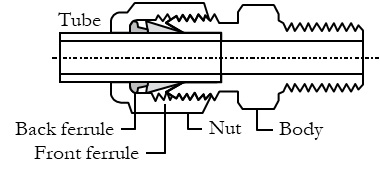
Figure 2 | Compression fitting
Comparison of Flared and Flareless Fittings
In summary, flared fittings are well-suited for connecting thin- to medium-diameter wall tubes. They offer ease of assembly and leak resistance. They are compatible with thin-walled tubes. They are often used in critical military, aerospace, and automotive braking systems applications.
Conversely, flareless fittings are suitable for connecting thick-wall tubes, providing advantages like ease of installation. This ease of installation ensures that you can comfortably and quickly set up your hydraulic systems. They also offer reliability in vibration-prone environments and a reduced risk of leaks. Remarkably, flareless fittings find extensive use in applications operating under extreme conditions. These conditions include high pressure, dust, shocks, vibration, and dynamic loading. They are usually used in oil and gas, mining, construction, agriculture, and forestry machinery/equipment.
A Final Note
Both fitting types are manufactured to stringent standards. Flared tube fittings adhere to the SAE J514 standard featuring a 37° flare. Flareless tube fittings also follow the SAE J514 standard. Each type of fitting offers unique advantages and is suitable for specific applications. Careful consideration is needed to decide the most appropriate choice for optimal reliability and performance in hydraulic systems.
Joji Parambath
Resource Person (Fluidsys Training Centre Pvt Ltd)
Author (Pneumatic, Hydraulic, and PLC books)
For hydraulic training / Pneumatic training:
For book details:
Reference: Industrial Hydraulics Systems and Circuits – Basic Level by Joji Parambath, Amazon KDP independent publishing. US UK DE FR ES IT NL PL SE JP CA AU

Industrial hydraulic technology is expanding and is as fascinating as ever. Hydraulic systems provide the muscle power to run the machines with the smoothest control possibilities. Many professionals design, construct, and maintain hydraulic systems every day. Several budding engineers are initiated into the technology of fluid power now and then. Therefore, spreading technological information on fluid power is essential for advancing fluid power technology. The textbook on ‘Industrial Hydraulics – Basic Level (in the SI Units)’ is written to meet this objective.
The textbook provides a thorough and detailed exploration of hydraulic systems, covering all essential components and circuits. It begins by laying down the fundamental principles necessary to understand the topic comprehensively. The content includes in-depth discussions on hydraulic fluids, filters, reservoirs, pumps, pressure relief valves, cylinders, and motors. It also delves into the intricacies of control valves, encompassing directional control valves, flow control elements, and pressure control valves. The book thoroughly examines hydraulic accumulators, fluid conductors, and various hydraulic applications, concluding with a comprehensive look at maintenance, troubleshooting, and safety considerations specific to hydraulic systems. Throughout the text, using the SI system of units is consistently emphasised.
The publication is designed to provide a comprehensive understanding of hydraulic system components, encompassing their functions, cross-sectional views, mathematical relations, symbols, advantages, and drawbacks. It extensively covers various terms, definitions, and mathematical relations related to hydraulic components, accompanied by many numerical examples to facilitate thorough analysis. Furthermore, it presents typical circuits utilising these components sequentially, progressing from simple to complex setups. Circuits in multiple positions and a summarisation of controls in a dedicated chapter offer a comprehensive overview of the different control aspects. At the end of each chapter, objective-type questions and review/numerical questions are provided to assess your comprehension of the subject matter. The appendices contain a wealth of valuable information. The language used throughout the book is straightforward, and the topics are logically arranged for enhanced comprehension.
The book has been authored by an experienced professional who has trained thousands of professionals and students for over 25 years. If you seek a deeper understanding of fluid power, this book is a valuable resource for your professional development journey.
 Fluidsys Training Centre Private Limited
Leave a comment