
Occupational safety and health are crucial for organizations as they enhance employee well-being.
Occupational Health Management
Occupational health management promotes and maintains all employee’s physical, mental, and social well-being. Stress, burnout, and fatigue often come from demanding work environments. These environments are marked by excessive hours and pressing deadlines. They also involve irregular shift patterns, and insufficient support systems. To combat these challenges, occupational health initiatives focus on ensuring that employees are well-suited to their roles, conducting necessary health evaluations, and rigorously assessing potential risks when personnel return to work after illness.
Occupational health risks can emerge from various factors, including physical, ergonomic, chemical, biological, behavioral, and social influences. Physical threats include disruptive noise, oppressive heat, and harmful radiation. Chemical dangers lurk in the form of dust, toxic gases, corrosive acids, hazardous alkalis, and heavy metals. These risks can result in various occupational diseases. Workers may suffer from debilitating injuries, chronic lung conditions, or different types of cancers. They might experience skin ailments like dermatitis and serious infections. Toxic exposures and mental health disorders can severely impact a worker’s quality of life.
Safe Working Practices
To cultivate a secure work environment, employees must actively engage in several activities. They must participate in regular review meetings, comprehensive training sessions, rigorous emergency safety drills, and meticulous safety audits. These training opportunities delve into essential safety protocols, procedures, and available resources. They provide an in-depth exploration of potential hazards and their classifications. Participants must learn vital skills for injury prevention and hazard management. They need to understand the critical importance of personal protective equipment (PPE). They must also master safe methodologies for working at heights. Protocols for navigating confined spaces are crucial. Additionally, strategies for effectively mitigating fire hazards should be learned. By fostering a culture of safety awareness, organizations can better protect their workforce and enhance overall workplace resilience.
Disclaimer: The information provided on this blog is for general informational purposes only. It is not a substitute for professional medical or safety advice. Always consult with a qualified healthcare professional or safety expert for any health or safety concerns you may have.
By
Joji Parambath
Fluidsys Training Centre Pvt Ltd
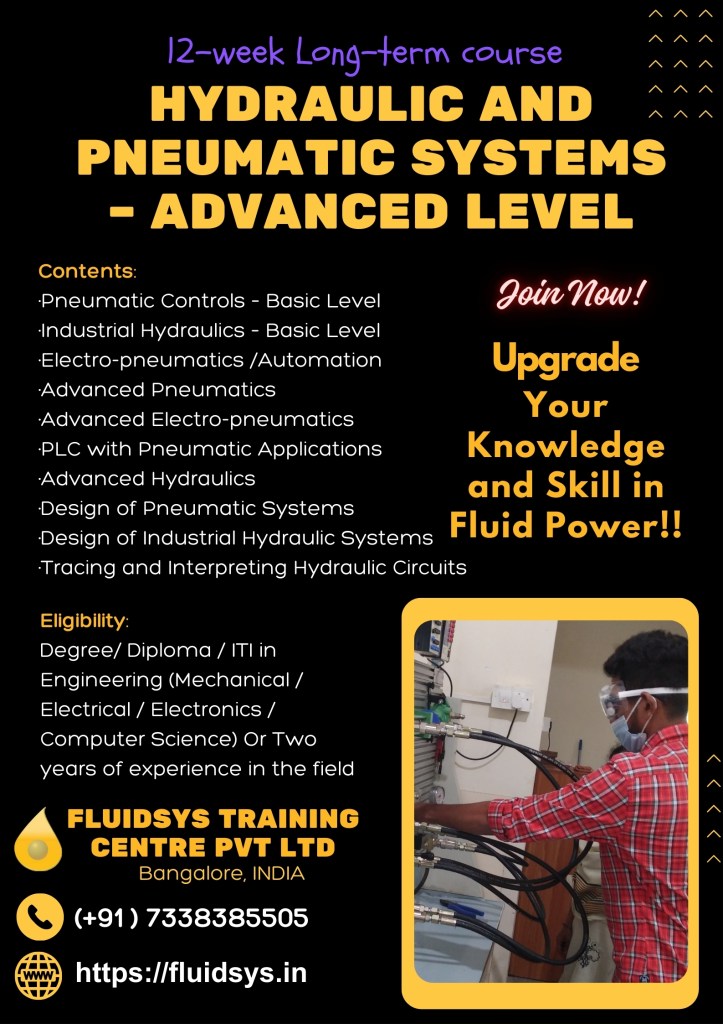
Fluidsys Training Centre Pvt Ltd., Bangalore offers a 12-week long-term course with the inclusion of this topic.
Long-term Course
Hydraulic and Pneumatic Systems – Advanced Level
Duration: 12 weeks (4 to 6 hours per day, Monday to Friday) / Flexible timings
Eligibility: ITI / Diploma / Degree in Engineering (Mechanical / Electrical / Electronics / Computer Science streams) Or Two years of experience in the field
Course Contents:
| Week 1 | Basic health and safety practices |
| Week 2 | Pneumatics – Basic level |
| Week 3 | Hydraulics – Basic level |
| Week 4 | Hydraulics – Basic level |
| Week 5 | Electro-pneumatics – Basic level |
| Week 6 | Pneumatics / Electro-pneumatics – Advanced level |
| Week 7 | Programmable Logic Controllers / HMI /SCADA |
| Week 8 | Hydraulics – Advanced Level [Hydrostatic Transmissions (HSTs), Load sensing systems, Proportional valves, Servo valves, Cartridge valves] |
| Week 9 | Design of typical Pneumatic and Hydraulic systems |
| Week 10 | Tracing of industrial and mobile pneumatic & hydraulic circuits / Maintenance and troubleshooting of pneumatic and hydraulic systems |
| Week 11 | Soft skills: Communication, Leadership, Interpersonal skills, Problem-solving and decision-making, Emotional intelligence, Team building, Time management, and Stress management |
| Week 12 | Optional: (1) Small project work or (2) Fitting, assembly, and testing of pneumatic and hydraulic systems |
Assessment: Continuous evaluation
Certificate: Issued by Fluidsys Training Centre Pvt Ltd
Contact:
Fluidsys Training Centre Pvt Ltd
No. 7, 1st Floor, 2nd Cross, Near WIMAC Circle
K G Halli, Jalahalli West, Bangalore – 560015 INDIA
Mob: (+91) 733838505
 Fluidsys Training Centre Private Limited
Leave a comment