Short-term Courses
Hydraulics
–Industrial Hydraulics – Basic Level (6 Days)
-Design of Industrial Hydraulic Systems (4 Days)
-Advanced Hydraulics (5 days)
-Tracing and Interpreting Hydraulic Circuits (4 days)
Pneumatics
-Pneumatic controls -Basic Level (4 Days)
–Electro-pneumatics and Automation (4 Days)
-Advanced Pneumatics (2 days)
-Advanced Electro-pneumatics (2 days)
-Design of Pneumatic Systems (2 Days)
PLC
-Programmable Logic Controller (PLC) with Pneumatic/Hydraulic Applications (4 Days)
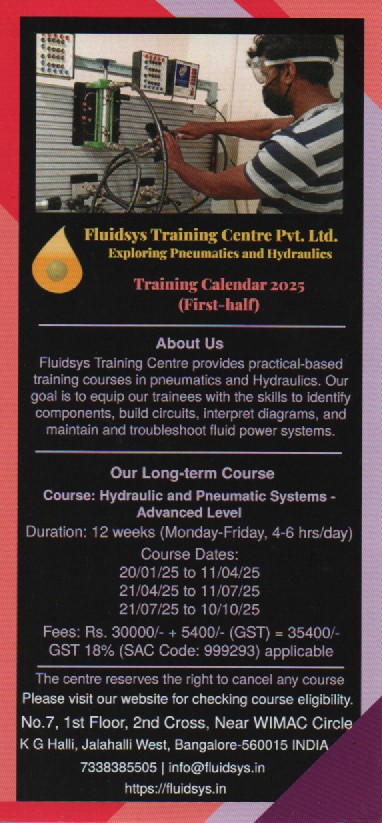
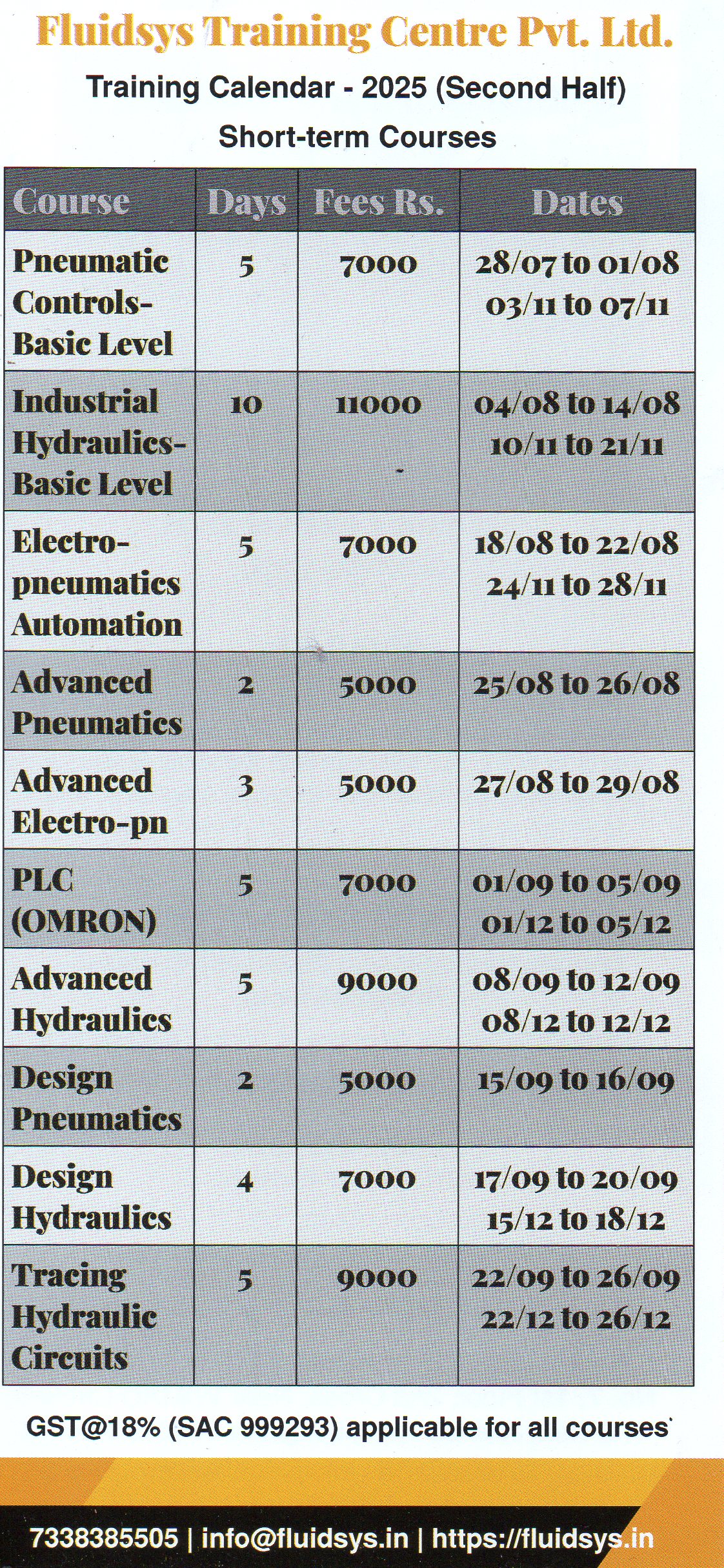
Course Calendar
Course Contents
Industrial Hydraulics – Basic Level (6 days)
On completion of the course, the participants will be able to understand the basic hydraulic concepts, functions and differentiating characteristics of the many hydraulic components. They will be able to develop hydraulic circuits using simulation software and construct, test and operate hydraulic circuits. They will also be able to interpret hydraulic drawings, identify the major hydraulic system components, and describe their expected function. The topic coverage includes: Basic hydraulic principles (Pressure, flow, force multiplication, etc), fluid characteristics, filtration, power pack, reservoir, pumps, pressure relief valves, hydraulic actuators, hydraulic symbols, directional control valves, check valves – direct and pilot operated, flow control valves – meter-in, meter out, bleed-off, pressure control valves, Accumulator basics, fluid conductors and fittings, and maintenance, troubleshooting, and safety precautions.
Design of Industrial Hydraulic Systems (4 days)
This course covers the topic of how to select and properly size components used in industrial hydraulic systems. The topics discussed include the selection and sizing of the reservoir, pumps, valves, actuators, heat exchangers, filters, and fluid conductors for a hydraulic system. The course is math-intensive, as basic math and physics are used to calculate the required performance specifications for various applications. After undergoing the course, the participants will get the knowledge in the systematic approach to the design of hydraulic systems.
Advanced Hydraulics (5 days)
On completion of the course, the participants will be able to understand the functions and applications of hydrostatic transmission systems (HSTs), load sensing systems, proportional valves, servo valves, and cartridge valve systems.
Pneumatic Controls – Basic level (4 days)
The basic course on pneumatic controls is tailored to impart the know-how of pneumatics to the requirements of the modern industries. The course covers, in detail, the safety aspects of pneumatic systems and the compressed air generation and preparation methods, pneumatic actuating mechanisms, various control techniques, and brief maintenance and troubleshooting aspects. The relevant ISO symbols are introduced. The classroom teaching is supplemented by the use of simulation software packages and power point presentations followed by practical sessions. Proper safety procedures and appropriate working practices are followed throughout the course, especially during the practical sessions. This course provides maintenance personnel and production operators with the skills and knowledge necessary to carry out maintenance tasks on pneumatic systems. On completion of the course, the participant will also be able to identify pneumatic components, develop/interpret control circuits, and carry out proper maintenance of pneumatic systems.
Electro-pneumatics and Automation (4 days)
The basic course on electro-pneumatic controls aims at empowering the participants with the skills to develop, construct, and test the electro-pneumatic circuits using a single actuator. The course also covers the functions and operation of a range of electrical control components and sensing devices. A number of electrical relay circuits are developed for controlling pneumatic systems. The classroom teaching is supplemented by the use of magnetic symbols, simulation software packages, power point presentations followed by practical sessions. Proper safety procedures and appropriate working practices are followed throughout the course, especially during the practical sessions. This course provides maintenance personnel and production operators with the skills and knowledge necessary to carry out maintenance tasks. On completion of the course, the participant will also be able to understand the construction and function of various components in electro-pneumatic control systems. He will also be able to identify and use control schematics, design, construct, and troubleshoot single-actuator electro-pneumatic circuits.
P L C (4 Days)
The course covers the following topics: Basics of Pneumatics / Hydraulics – Power source, actuators, solenoid valves, PBs, and sensors, Hard-wired Control Systems, Programmable Control Systems, Hardware aspects of PLCs: System Components, CPU, Memory organization, Power Supply unit, I/O Section, Analog/Digital I/Os, Modular PLCs, Software aspects of PLCs: Operating System, Hardware configuration, User programs, Program scan-cycle, Programming elements: Bit logic operations, NO contact, NC contact, Coil, Timer, Counter, Multiple actuator programs, and Program techniques.
Note: Practical exercises with Pneumatic / Hydraulic systems will be carried out using OMRON PLC.
Advanced Pneumatics (2 days)
The course is a natural progression from the basic level pneumatic course. Therefore, prior knowledge of the basic pneumatics is necessary for the proper understanding of the advanced level course. The course covers the safety aspects of pneumatic systems and the control techniques of multiple actuator circuits using the cascade method and the shift register method. The participant will be tested for their skills in developing, constructing, and testing advanced industrial pneumatic circuits using our hands-on trainer kits. The course is suitable for anyone who is required to design or maintain industrial pneumatic systems.
Advanced Electro-pneumatics (2 days)
The course is a continuation to the basic level electro-pneumatic course. The course comprehensively covers the control techniques of multiple actuator electro-pneumatic circuits using the cascade method and the shift register method. The participant will be tested for their skills in designing, constructing, and testing advanced industrial electro-pneumatic circuits. The course is suitable for design engineers, plant engineers, maintenance staff and instructors involved in the industrial electro-pneumatic systems.
Eligibility for Short-term Courses
ITI/ Diploma/ Graduate in Engineering / Technology or experienced processionals in the relevant field
 Fluidsys Training Centre Private Limited