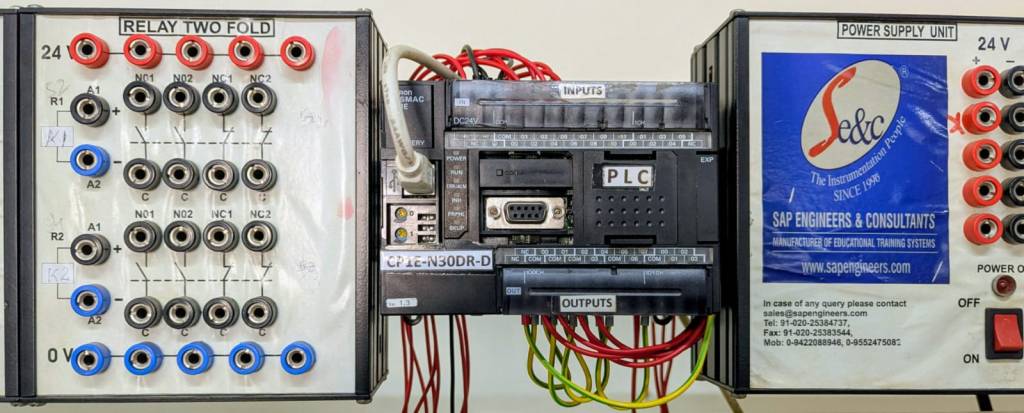
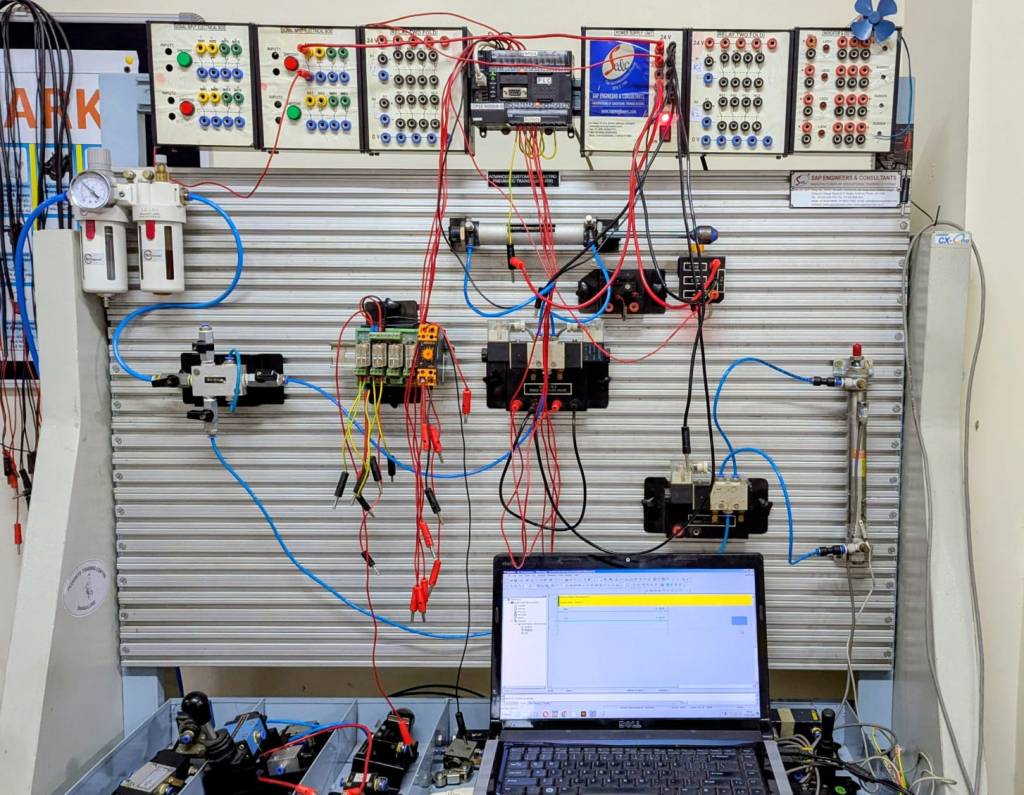
Learn how to program, operate, and troubleshoot PLC-controlled electro-pneumatic systems through extensive hands-on laboratory sessions.
Course Information
✅Programmable Logic Controllers Using OMRON PLCs
| Level | Professional |
| Duration | 5 Days |
| Delivery Mode | Classroom / Corporate |
| Practical sessions | Extensive Hands-on Laboratory Sessions |
| PLC make | OMRON |
| Next Batch | On request |
| Course Fee (Per trainee per course) | ₹7,000 + GST* (or “Contact for quotation”) |
| Seats Available | 08 |
| Certificate | Yes |
Note:
*GSTIN: 29AADCF0201A1ZJ
*SAC Code: 999293 (Commercial Training and Coaching Services)
Course Overview
Programmable Logic Controllers (PLCs) are the heart of modern industrial automation. This practical course provides a comprehensive introduction to PLC hardware, programming, troubleshooting, and industrial applications using OMRON PLC systems. Participants learn how PLCs interact with sensors, switches, timers, counters, memory functions, and electro-pneumatic actuators to control automated machinery safely and efficiently.
This intensive five-day programme combines classroom instruction with extensive hands-on programming exercises, practical implementation, and industrial automation projects.
Participants learn how external electrical input devices and sensors, together with internal PLC timers, counters, and memory functions, interact with pneumatic actuators to create reliable automated machine sequences.
This course provides a strong foundation for advanced electro-pneumatic PLC system design and industrial automation applications.
Typical Industrial Applications
Participants learn PLC-based sequence control techniques widely used in:
- Conveyor systems
- Automatic filling machines
- Bottle packaging lines
- Assembly stations
- Material handling systems
- Pick-and-place robots
- Traffic signal control
- Industrial automation systems
Learning Outcomes
After successfully completing this course, participants will be able to:
✔ Identify PLC hardware components and explain their functions.
✔ Configure PLC hardware and software.
✔ Interpret PLC input/output (I/O) addressing and wiring diagrams.
✔ Develop PLC programs using bit logic instructions.
✔ Develop PLC programs using timer instructions.
✔ Develop PLC programs using counter instructions.
✔ Develop PLC programs using memory functions.
✔ Develop PLC programs for electro-pneumatic control systems.
✔ Develop PLC programs using analogue instructions.
✔ Develop PLC programs for industrial automation applications.
✔ Troubleshoot PLC-controlled systems.
Who Should Attend
Anyone with a technical background is welcome to join our courses! That said, we especially encourage technicians, professionals, and engineers in these areas to take full advantage of what we offer.
- Maintenance Engineers
- Design Engineers
- Commissioning Engineers
- Service Engineers
- Faculty Members
- Engineering Students
- Diploma Holders
- Industrial Technicians
- Plant Managers
- Corporate Training Coordinators
Prerequisites
Knowledge of basic-level electro-pneumatics is recommended. A technical background such as engineering, diploma, ITI, industrial maintenance, or related technical experience is beneficial.
Course Content
Module 1
Hardware and software aspects of PLCs
Module 2
Programming using bit logic PLC instructions for simple applications and implementation
Module 3
Programming using PLC bit logic instructions for single-actuator electro-pneumatic applications and implementation
Module 4
Programming using PLC timing instructions for single-actuator electro-pneumatic applications and implementation
Module 5
Programming using PLC memory instructions for single-actuator electro-pneumatic applications and implementation
Module 6
Programming using PLC counting instructions for single-actuator electro-pneumatic applications and implementation
Module 7
Programming using PLC instructions for multi-actuator electro-pneumatic applications and implementation
Module 8
Programming using PLC analog instructions
Module 9
Programming Techniques Using Binary Scaling
Module 10
Programming Using PLC Instructions for a Pedestrian Crossing Control System
Module 11
Programming using PLC instructions for additional applications
Module 12
Troubleshooting PLCs
Programming Topics Covered
- Bit Logic Instructions
- Timer Instructions
- Counter Instructions
- Memory Instructions
- Analogue Instructions
- Sequential Programming
- Electro-pneumatic Control
- Industrial Automation Applications
Extensive Hands-on Practical Training
Participants gain practical experience using:
- Compressors
- Pneumatic cylinders
- Pneumatic rotary actuators
- Solenoid-operated directional control valves
- Flow control valves
- Limit switches
- Reed switches
- Pushbuttons
- Selector switches
- Indicator lamps
- Proximity sensors
- Pressure switches
- PLC hardware
- PLC software
- Programming instructions
Practical Skills Developed
Participants learn to:
- Develop PLC programs
- Test and verify logic
- Monitor PLC operation online
- Diagnose programming errors
- Troubleshoot input/output faults
- Commission PLC-controlled electro-pneumatic systems
Training Methodology
Through practical training, real industrial components, modern laboratories, technical publications, and industry-oriented teaching, we help participants convert engineering concepts into practical skills that can be confidently applied in industrial electro-pneumatic systems.
Progressive PLC Program Development Assignments
Participants complete a series of progressively challenging PLC programming assignments covering machine control, electro-pneumatic automation, timers, counters, memory functions, analogue instructions, and industrial automation applications.
Training Methodology
Through practical training, real industrial components, modern laboratories, technical publications, and industry-oriented teaching, we help participants convert engineering concepts into practical skills that can be confidently applied in PLC-controlled industrial automation and electro-pneumatic systems.
Why Choose This Course?
🧰 Practical Laboratory Sessions
⚙ Real Industrial Components
📚 In-depth Course Material
📖 Structured Course Notes
👨🏫 Experienced Faculty
🏆 Certificate of Completion
Frequently Asked Questions
Do I need prior experience?
Knowledge of basic electro-pneumatics is recommended.
Is prior PLC programming experience required?
No. The course begins with PLC fundamentals before progressing to advanced programming concepts.
Can organizations request customized training?
Yes. Training can be tailored to your equipment and operational requirements.
Are practical sessions included?
Yes. Practical laboratory sessions are an integral part of the course.
Are course materials provided?
Yes. Comprehensive course notes and supporting learning materials are provided to all participants.
Will I receive a certificate?
Yes. Participants receive a certificate upon successful completion of the programme.
Course Enquiry & Registration


Contact Information
📍 Training Centre
Fluidsys Training Centre Pvt Ltd
No. 7, First Floor, Near WIMAC Circle
Kammagondanahalli (K G Halli)
Jalahalli West, Bangalore
Karnataka, India – 560015
📞 Phone
(+91) 7338385505
info@fluidsys.in
(+91) 7338385505
🕒 Office Hours
Monday to Saturday
9.00 am to 5.00 pm

